
As we cross the mid-point of the year, and approach the Fall midterm elections, higher interest rates and stubborn inflation continue to provide headwinds for real estate values. At the same time, balanced fundamentals across several property types are providing opportunities for value creation. How this feels to the investor is all a matter of where you sit.
At the end of 2024, the U.S. 10 yr treasury rate was 4.5%. By the fall of 2025, treasuries had fallen to 4.0%, and while still higher than hoped for, it drove a strong first quarter of property sales and refinancing transactions. However, the second quarter saw a sharp pullback in transaction volume due to the war in Iran, higher inflation reports and treasury yields rising back above the 4.5% level. As a result, delinquencies have risen in both office and multifamily loans as the wall of maturing high-leverage, low-interest rate loans from the last cycle comes due.
U.S. 10 Year Treasury Rates (Mar-July 2026)
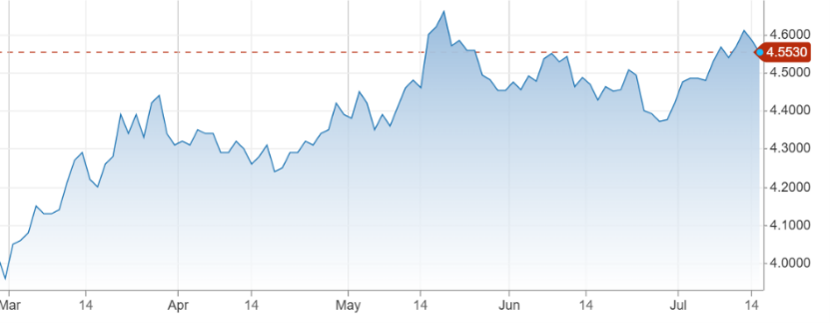 After the Great Financial Crisis in 2008-2009, interest rates fell continually until 2022. Real estate values rose sharply during this same period, primarily a result of the corresponding drop in cap rates, not improved property fundamentals. Instead, increased supply, fueled by abundant low interest debt, continued to pour into the market, dampening rent growth across most sectors. In 2022, we entered an adjustment period during which rates rose dramatically in a short period of time to combat rising inflation, and of course, property values plummeted as cap rates rose as the market adjusted to a sustained higher interest rate environment. The overhang of excess supply from the previous low-rate environment only made matters worse.
Real estate is a cyclical business. Pundits continually talk about the market bottoming, recovering, peaking or falling. Each phase of the cycle tends to last for an extended period. It takes a long time to acquire a property, conceive a plan, secure approvals and construct or alter a building. It is also very difficult to put the brakes on when the market turns. A building under construction, or a project mid-stream in a value-add business plan, almost always gets completed despite the economic climate.
This is all by way of saying that the current adjustment cycle which started in 2022 likely has more time to run. There are several market vulnerabilities in the Washington, DC region that need to be addressed before another broad upswing occurs. First is the overhang of office inventory. While there is little new construction, the Washington DC region continues to struggle with vacancy rates across the area hovering above 20%. Second, there are still almost fifteen thousand apartment units under construction in the region, all of which will be delivering into a softer rental market. Third, there is still a significant amount of “last cycle” low interest debt that is either coming due, or in default, and needs to be resolved.
While the current climate presents challenges, property fundamentals are more compelling than they have been in some time. On the office front, net demand has turned positive in Northern Virginia, while DC absorption was flat, an improvement in the years since COVID-19. In both markets, virtually no new office buildings are under construction, and the Washington region’s country-leading conversion trend continues to reduce office inventory. Look for regional office vacancies to fall over the next few years as inventory contracts and demand stabilizes.
Apartment supply is also falling as developers and capital pulled back in response to the region’s drop in employment in 2025. Deliveries in 2026 are the lowest in recent years at ~10,000 units (roughly 2/3 the historical average) and new permits for 2026 are estimated to be about 5,000 units. After a flat 2025, the region absorbed 2,700 units in Q1 2026. Supply is moving in the right direction, and the regional housing shortage persists, creating pent-up demand. There is also recognition by jurisdictions across the region that high interest rates and rising construction costs are exacerbating this shortage, and some are meeting this challenge head-on in the form of incentives and regulatory reform.
Across the Washington metropolitan region, local governments are actively reshaping land use policy in response to persistent office vacancy, strong housing demand, and infrastructure constraints. Below are a few of the programs local governments have recently implemented to improve project feasibility:
- Washington, DC – Housing in Downtown CBD (tax abatements and financial incentives for conversions)
- Washington, DC – Office to Anything (incentivizes office to commercial and institutional uses)
- Montgomery County, MD – Commercial-to-Residential Reconstruction (CRR)
- Fairfax County, VA – Office Adaptive Reuse
Jurisdictions are working in a more collaborative way with developers to address both the housing shortage and reduced commercial property tax base due to falling office values.
That is not the same attitude that the public sector is bringing to data centers. Jurisdictions are restricting by-right development, applying stricter location and design standards, scrutinizing electric grid, water and infrastructure impacts and generally slowing down the approval process.
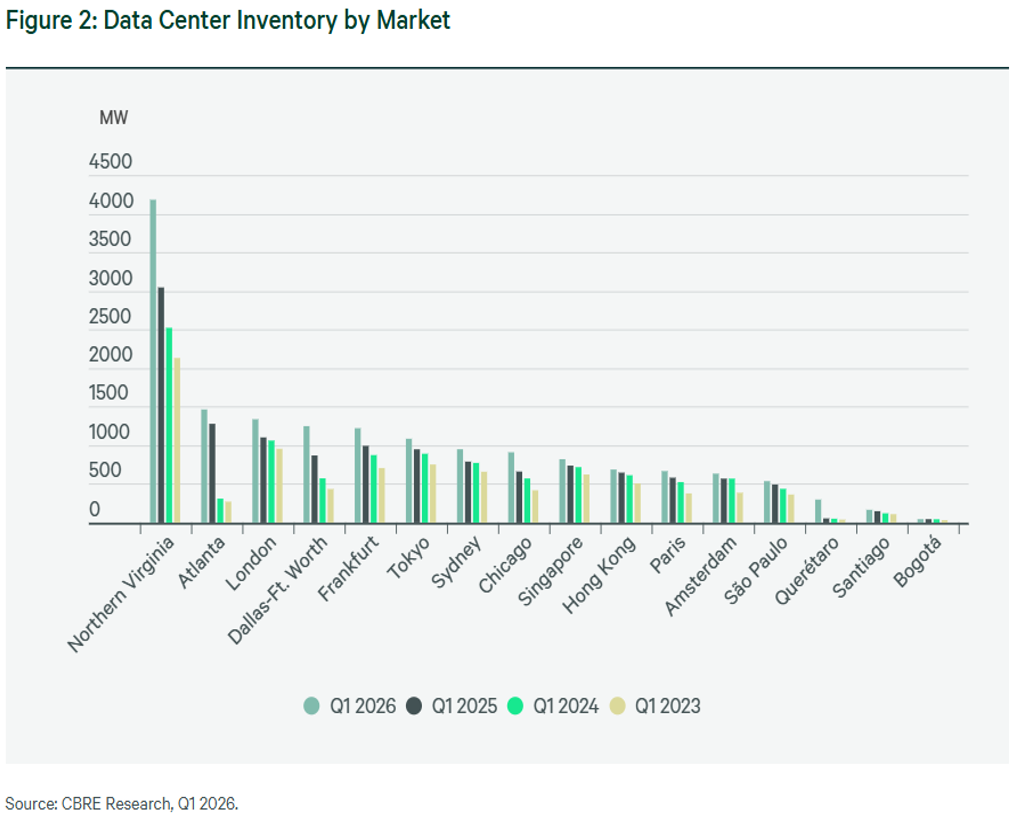 Even in Northern Virginia – the largest data center market in the world – demand for data center space will be hard to meet in the near term. For instance, Loudoun County eliminated by-right data center development in March 2025, and Prince William County has moved to retire its Data Center Overlay District entirely, effectively ending by-right development there as well. CBRE’s June 2026 report captures Northern Virginia’s recent data center climate and this imbalance:
“Strong leasing activity persisted despite ongoing power supply challenges, driving net absorption of 1,148.3 MW—the greatest absorption increase of any market since CBRE’s first global data center report in 2023. The market’s overall vacancy rate fell to an all-time low of 0.3%, while average rental rates continued to rise amid robust demand.” – CBRE, Global Data Center Trends 2026
The data center development boom in Northern Virginia is also creating industrial demand. Contractors working on these large-scale, technically complex construction projects need staging, storage and laydown space proximate to their sites even as these projects themselves absorb existing industrial-zoned land or replace existing industrial properties. The result is a squeeze on both sides: demand for industrial space is rising while supply is being converted away. Accordingly, the industrial sector is another area where supply/demand dynamics look more favorable going forward.
The current environment continues to present investment opportunities in office conversions and in out-of-balance and defaulted debt in the region. At the same time, unmet demand in multifamily, industrial, and data centers will present opportunities with strong underlying fundamentals going forward. We may be entering a rare period in which opportunistic pricing coexists with improving fundamentals and clear supply constraints. That combination does not come around often, and the smart investor will take advantage of this moment.