
“Economists are often asked to predict what the economy is going to do. But economic predictions require predicting what politicians are going to do – and nothing is more unpredictable.” Thomas Sowell
As the midterm elections approach, the uncertainty that is contained in economist Thomas Sowell’s quote resonates, and given the times, we will add the unknown of who the politicians will be once elected. We will find out soon enough. Therefore, this quarter’s report will be short on predictions but instead will look back at the last two years and see the evolution of the Washington area economy over that time. Hopefully, you will get a good picture of where the region stands today.
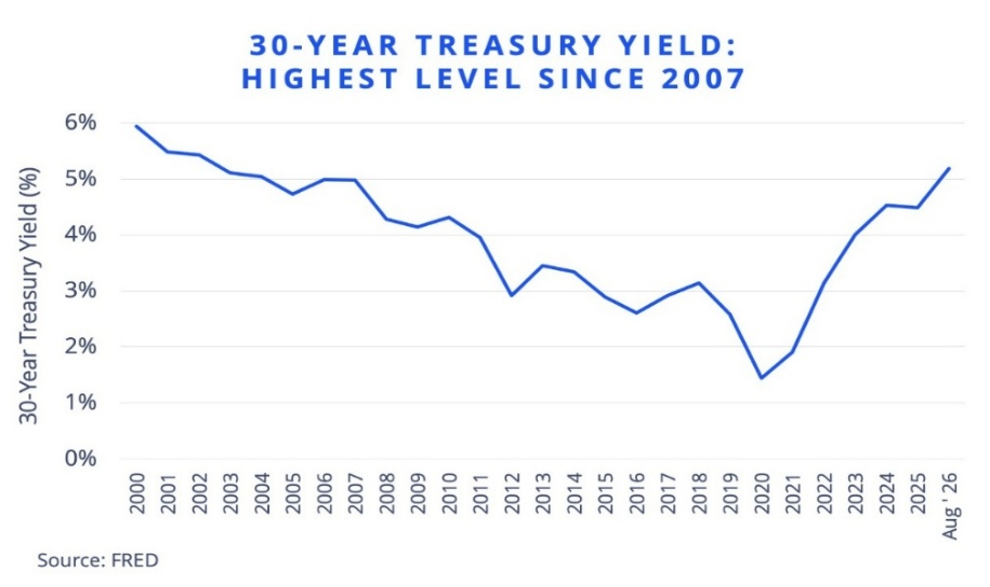 However, before taking a deep dive into the regional economy and real estate environment, we must pause and discuss the adjacent chart. Real estate is one of the most sensitive industries to interest rate changes, and while most everyone reading this report is aware of these numbers, the rapidity with which rates have risen compared to the 20 years of slowly falling rates from 2000 to 2020 has applied pressure to capital stacks across all property types. One must go back a long way before seeing rates at this level. The consequences of these higher rates have not yet played out fully, but if you are an owner of real estate that has an extended, non-performing loan or are facing maturity of your performing loan and need to refinance, this is not a pleasant time. These rates are also affecting acquisitions and acquisition loans, and, therefore, property values. In a recovering real estate market with better balance between supply and demand across many asset classes, interest rates at this level, or higher, as some predict, will provide serious headwinds going forward.
The Washington Region Economy
As we look at the economy of the local Washington Region, which has been much in the news after enduring reduced federal employment, the re-naming and then closing of the Kennedy Center, deployment of the National Guard, the White House reconstruction and the proposed Triumphal Arch at Arlington Cemetery, among other local Federal initiatives, the vibrancy and resilience of the Region has been challenged. However, the breadth of advantages that the Region has, namely its educated workforce, quality of life, and, yes, the federal government’s presence has continued to serve it well.
“As Greater Washington continues to recover from the sharp federal government contraction of 2025, progress in 2026 has been supported by strong demand for commercial and residential space, a healthier labor market, record levels of mobility and visitation and the stabilization of federal government employment and contracting activity.” CBRE Revive Index – September 30, 2026
Northern Virginia has accounted for most of the 50,000-person growth in population in the DC area. Moreover, Northern Virginia’s share of the Region’s population growth has increased from an annual average of 50% to 75%. The main reason is that the District of Columbia’s population has been flat recently. While this seems logical given government cutbacks of approximately 60,000 jobs, it turns out that most of those government workers lived outside of Washington. In fact, with the addition of layoffs in the government contractor space, the largest drop in employment in the region has been in Northern Virginia. The head scratcher here is that as Northern Virginia has had the largest drop in employment, at the same time, it has had the greatest increase in population. One reason for this anomaly may be the spate of early retirements by government workers. Another reason for Northern Virginia’s growth may be the recent acceleration in government defense spending, which has driven new job creation from defense, intelligence and AI tenants and begun to offset the private contractor job losses that followed the 2025 federal workforce reductions. Either way, Northern Virginia continues to lead the way as the Region’s primary economic engine.
Several metrics bode well for Northern Virginia. Its unemployment rate is a low 3.3%, compared to 3.8% for the Region and 4.2% for the US. Apartment absorption remains strong, continuing a five-year run of positive absorption and the data center market is still booming. The estimated upcoming three-year data center development spend in Northern Virginia is $30 to $50 billion. To put this into context, this is three to four times more than the total spend on all new apartment projects in the Region over the next three years and is more than the total spend on all private commercial projects in the region over that same time frame.
The Northern Virginia story continues to point to two product types. The first is industrial where vacancy stands at just 3.9%. Not only is data center development creating significant opportunities for contractors who work in that space, it is also absorbing the industrial-zoned land that they need faster than it can be replaced. This phenomenon is pushing rents and creating pressure for existing and new tenants alike. The second is housing. The DC area still suffers from an acute housing shortage – the Region needs approximately 75,000 more homes by 2030 than are currently in the pipeline – and Northern Virginia has been at the forefront of conversions and rezonings to create supply, particularly through office conversions and change-of-use projects.
Stepping back to the Region as a whole, the picture across property types is one of sharp divergence and uneven recovery.
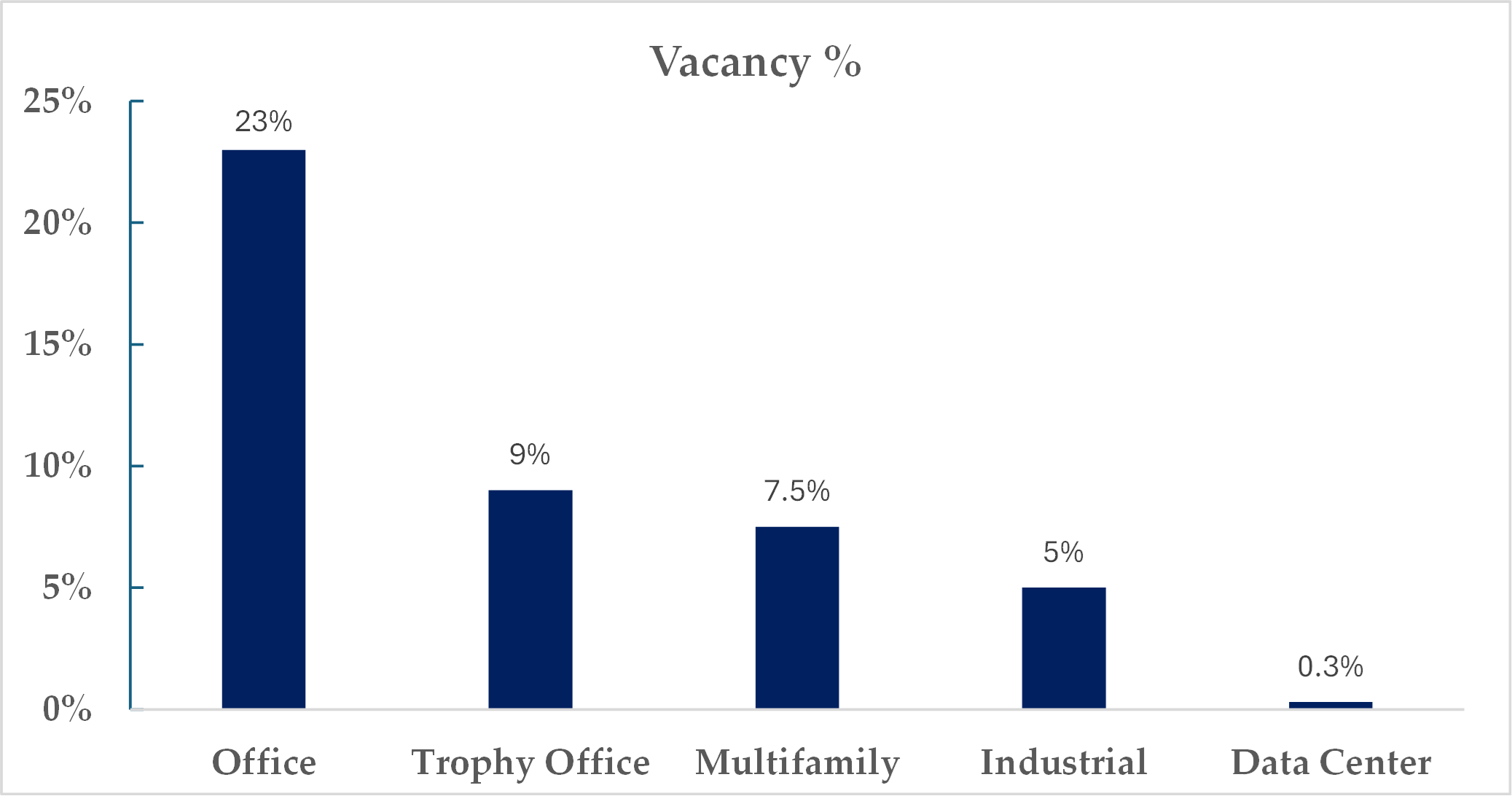 While commodity office is seeing positive absorption for the first time in years, there is still a long way to go to recovery and vacancy rates remain historically high. Trophy office rents continue to soar and supply remains muted, creating real demand for the highest quality office properties. Multifamily rents have risen less than the US overall, but solid absorption will lead to lower vacancy over time with limited supply on the horizon. Industrial rents continue to climb across the Region in this supply/demand balanced sector but demand remains flat in some submarkets in spite of this, and the gap between well-located, functional product and the rest is widening. Data Center demand is extraordinary, but public opposition has been building and there is a growing list of rejected or abandoned projects in our area.
While the Washington Region has experienced negative growth overall during the last year, almost all property types experienced some positive absorption in the third quarter. The dispersion of vacancy rates in the chart to the left tells a story of dramatically different health between property sectors and demonstrates that opportunities exist for value growth in some segments. As we have pointed out in recent reports, this continues to be an interesting investment market characterized by strong fundamentals in some sectors and distressed property opportunities in others.